Research Interests
Gravity is my favourite force. More than a hundred years ago,
Einstein gave us a beautiful geometrical framework to describe it,
but much remains to be understood: how gravity manifests itself
observationally, and how it fits consistently with the other
interactions and with our broader understanding of Physics.
My research lies at the interface between theory and experiment,
with the aim of understanding better how gravity works and what
it can teach us about fundamental physics.
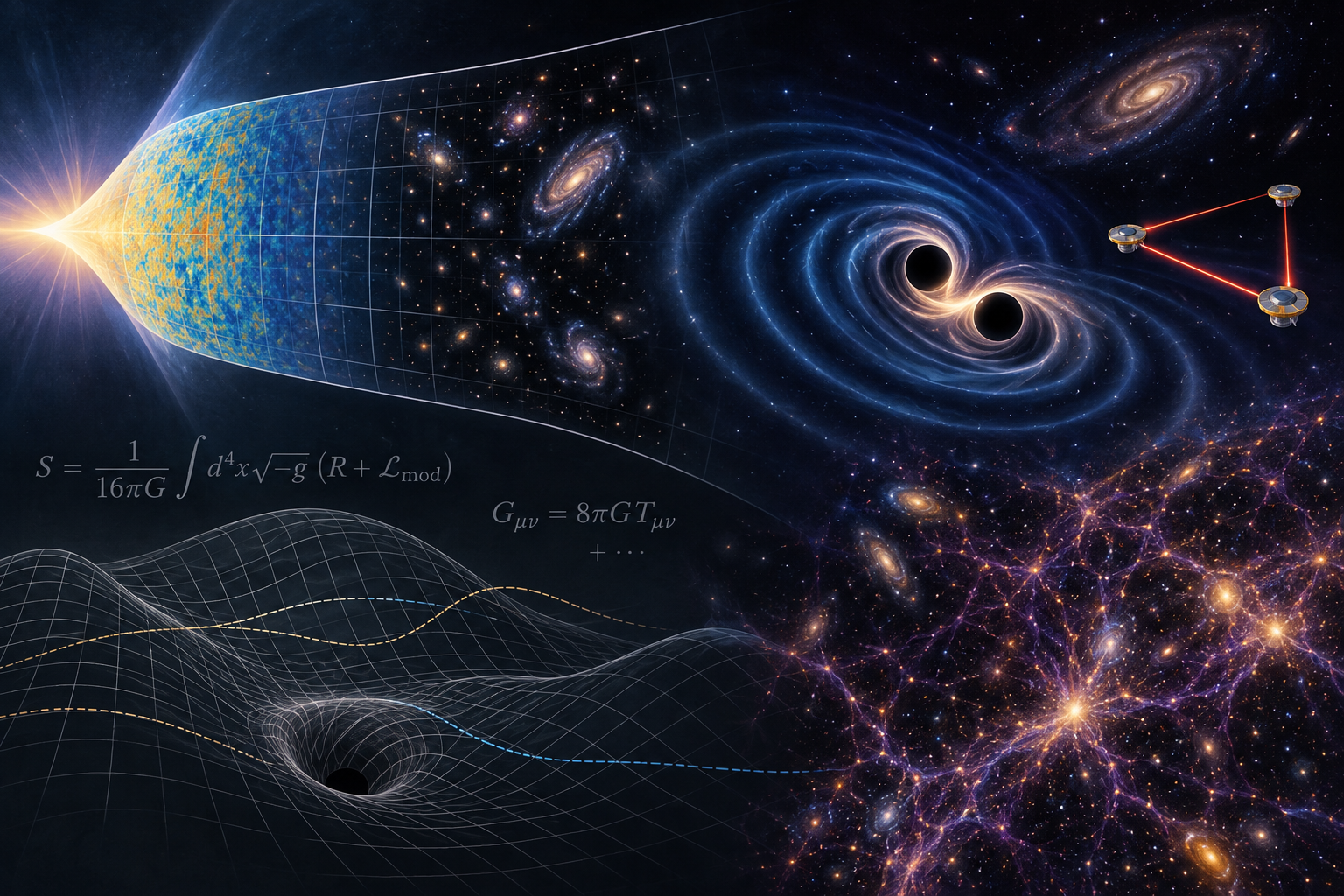
Cosmology
Gravity plays a central role in cosmology, the study of the origin,
evolution, and contents of the Universe. Because gravity acts over
enormous distances, it is the force that shapes the Universe on its
largest scales. My research explores open questions in both the early
and late Universe.
Early Universe
How did the Universe begin? I am interested in building consistent
models of cosmological inflation and in developing observational
probes that can test them.
Dark Energy and Dark Matter
What are dark matter and dark energy? Most of the present-day
Universe is made of components whose nature we still do not
understand. There are, however, many exciting theoretical ideas
and rapidly improving observations that may help us uncover
what they are.
Gravitational Waves
Gravitational waves are ripples in spacetime that travel across
the Universe at the speed of light. Predicted by General Relativity
and now directly observed, they have opened a new way of exploring
the cosmos. They can be produced by merging black holes and neutron
stars, but also by more exotic processes in the early Universe.
From Theory to Experiments
How are gravitational waves produced, and how do they travel
from their sources to us? I study the physics of their generation
and propagation, developing theoretical tools that help us
interpret observations and connect them with fundamental physics.
From Experiments to Theory
What can gravitational-wave observations teach us about gravity
and the Universe? I am involved in several gravitational-wave
experiments and collaborations across very different frequency
ranges, including NANOGrav, SKA, LISA, and the Einstein Telescope.
I am particularly interested in using their measurements to test
gravity, cosmology, and fundamental physics.
Theories of Gravity
Sometimes the best way to understand a theory is to look at it
from the outside and compare it with possible alternatives.
I am interested in developing theories of gravity beyond General
Relativity, both to explore new physical possibilities and to better
understand the remarkable structure — and possible limitations —
of Einstein's theory.
Building Theories of Modified Gravity
How can we construct consistent alternatives to General Relativity
that remain compatible with observations? This is surprisingly
difficult. I am interested in developing new theoretical methods
to build such theories and in identifying distinctive predictions
that could allow us to tell them apart from General Relativity.
The Physics of Black Holes
What do black holes look like in alternative theories of gravity?
At first sight, they can be remarkably similar to those of General
Relativity, but subtle differences may have important consequences
for both fundamental theory and observations.
Publications and Research Group
My publications on INSPIRE ↗
Cosmology & Gravity @ Swansea ↗
Group Seminars
We are a group of enthusiastic researchers on the topics above.
See our group’s upcoming seminars.
View the seminar programme →